Anatomy Trains Structural Integration
Anatomy Trains Structural Integration (ATSI) is a whole-body approach bringing together precise hands-on fascial work, movement and postural observation. It was developed by Tom Myers within the wider tradition of Structural Integration.
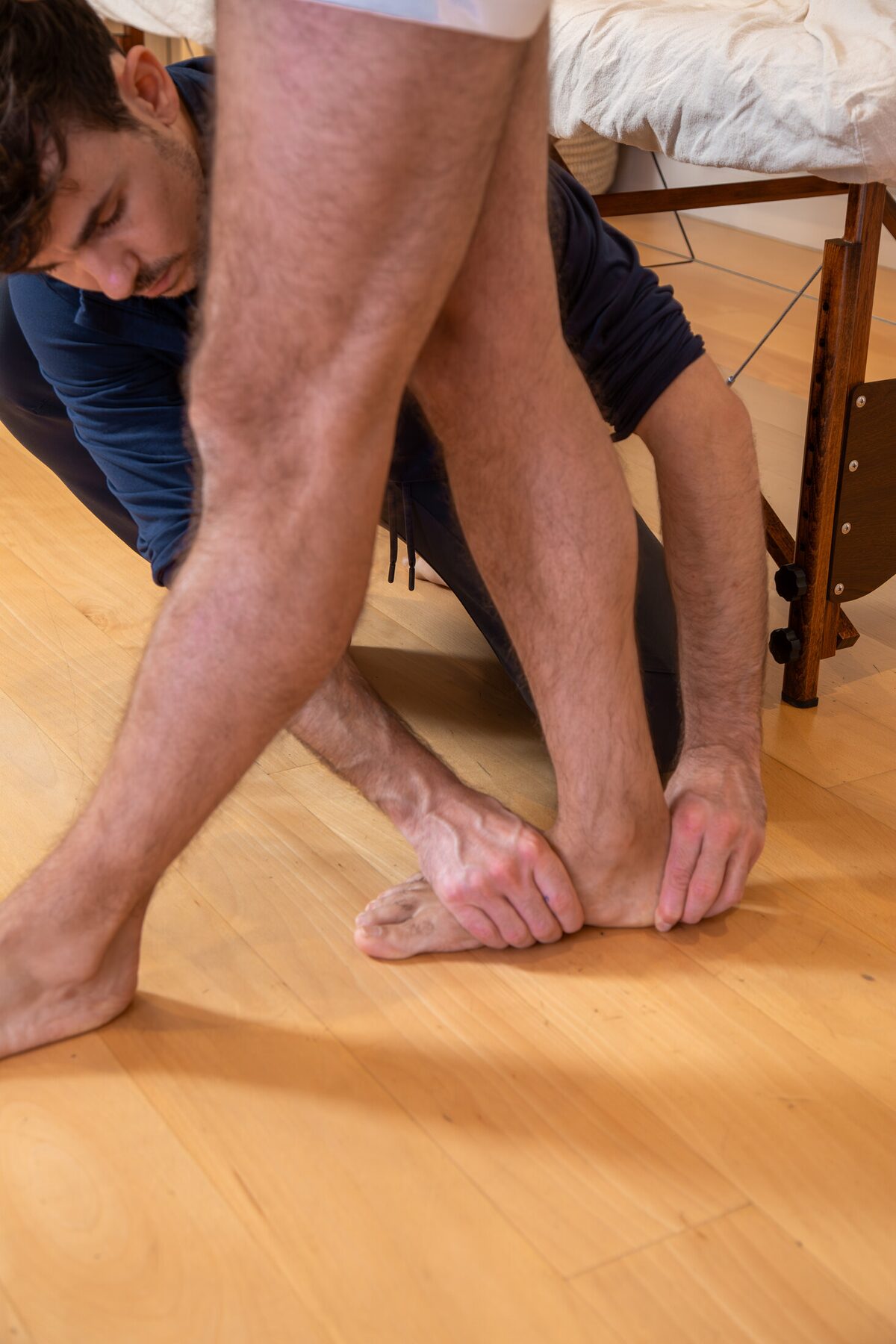
Rather than approaching the body as a collection of separate parts, ATSI looks at the relationships between them: how the feet relate to the pelvis, how the ribcage is organised over the legs, how the head and shoulders are supported, and how these relationships influence the way a person stands and moves.
Central to the work is fascia—the continuous connective tissue network through which the body's different structures relate and communicate. Tension or restriction in one area may therefore affect how movement, weight and support are organised elsewhere.
Through BodyReading, observation, conversation and movement are brought together to understand not only what is happening structurally, but how that particular organisation may have developed and how it is experienced by the person. This informs the hands-on work, while movement allows changes to be explored actively rather than simply received.
The aim is not to impose an idea of "correct" posture, but to explore what might allow the body to move towards greater balance, adaptability and a more harmonious relationship between structure and movement.
The Anatomy Trains model
The Anatomy Trains model was developed by manual therapist and educator Tom Myers as a way of describing continuity through the body's myofascial tissues.
Traditional anatomy is often taught by separating the body into individual muscles. That remains important, but it can obscure the way muscles and fascia connect into longer continuous pathways.
Anatomy Trains maps a number of these myofascial continuities through the body. They offer a framework for considering how one region may relate mechanically and functionally to another—including areas some distance apart.
This does not suggest that every restriction has a distant cause, or that one part of the body can be explained entirely through another. It provides a broader lens through which local anatomy can be understood as part of a connected system.
Within Structural Integration, this makes it possible to look beyond the site at which something feels restricted and to consider how that area participates in the organisation of the person as a whole.
A development within the Structural Integration tradition
Although Anatomy Trains provides ATSI with its distinctive anatomical framework, the method belongs to a much longer tradition.
Structural Integration originated with the work of Dr Ida P. Rolf, whose exploration of connective tissue, human structure and the body's relationship with gravity established the foundations of the field.
Tom Myers trained with Dr Rolf and went on to spend decades practising, teaching and developing Structural Integration. ATSI grew from this lineage, while bringing a distinct anatomical model and organisation to the work.
Dr Ida P. Rolf and the origins of Structural Integration
Dr Ida Pauline Rolf was an American biochemist who earned her doctorate from Columbia University in 1920 and later worked in organic chemistry at the Rockefeller Institute.
Her interest increasingly turned towards human structure and the relationship between connective tissue, movement and gravity. Rather than looking only at individual muscles or symptoms, she considered how the body's segments relate to one another within the gravitational field.
Her work developed into a systematic combination of hands-on work and movement education, eventually organised as a sequence of ten sessions designed to address the body progressively as a whole.
This became known as Rolfing Structural Integration, and the school she founded continues today as the Dr Ida Rolf Institute.
The terms are related but not interchangeable. Structural Integration describes the broader field that grew from Rolf's work; Rolfing refers specifically to the method and practitioners certified through the Dr Ida Rolf Institute.
From Rolfing to Anatomy Trains
As practitioners trained in Rolf's work went on to teach and develop their own approaches, a number of distinct schools and lineages emerged. They share a historical foundation while differing in their anatomical models, teaching and organisation of the work.
Having studied directly with Ida Rolf, Tom Myers continued to practise Structural Integration while studying movement, anatomy and other approaches to the body. During the 1990s, while teaching fascial anatomy, he began developing what became the Anatomy Trains map of myofascial continuities.
This model offered another way of understanding and organising the progression of Structural Integration. Rolf's original ten-session framework was reconsidered through the relationships described by Anatomy Trains, eventually developing into the twelve-session ATSI series.
Anatomy Trains Structural Integration is therefore closely connected to the work of Ida Rolf, but it is not simply Rolfing under another name.
It is a distinct development within the Structural Integration tradition, with its own curriculum, anatomical framework and process.
How ATSI is practised
ATSI brings observation, conversation, hands-on work and movement into one unfolding process rather than treating them as separate parts of a session.
BodyReading
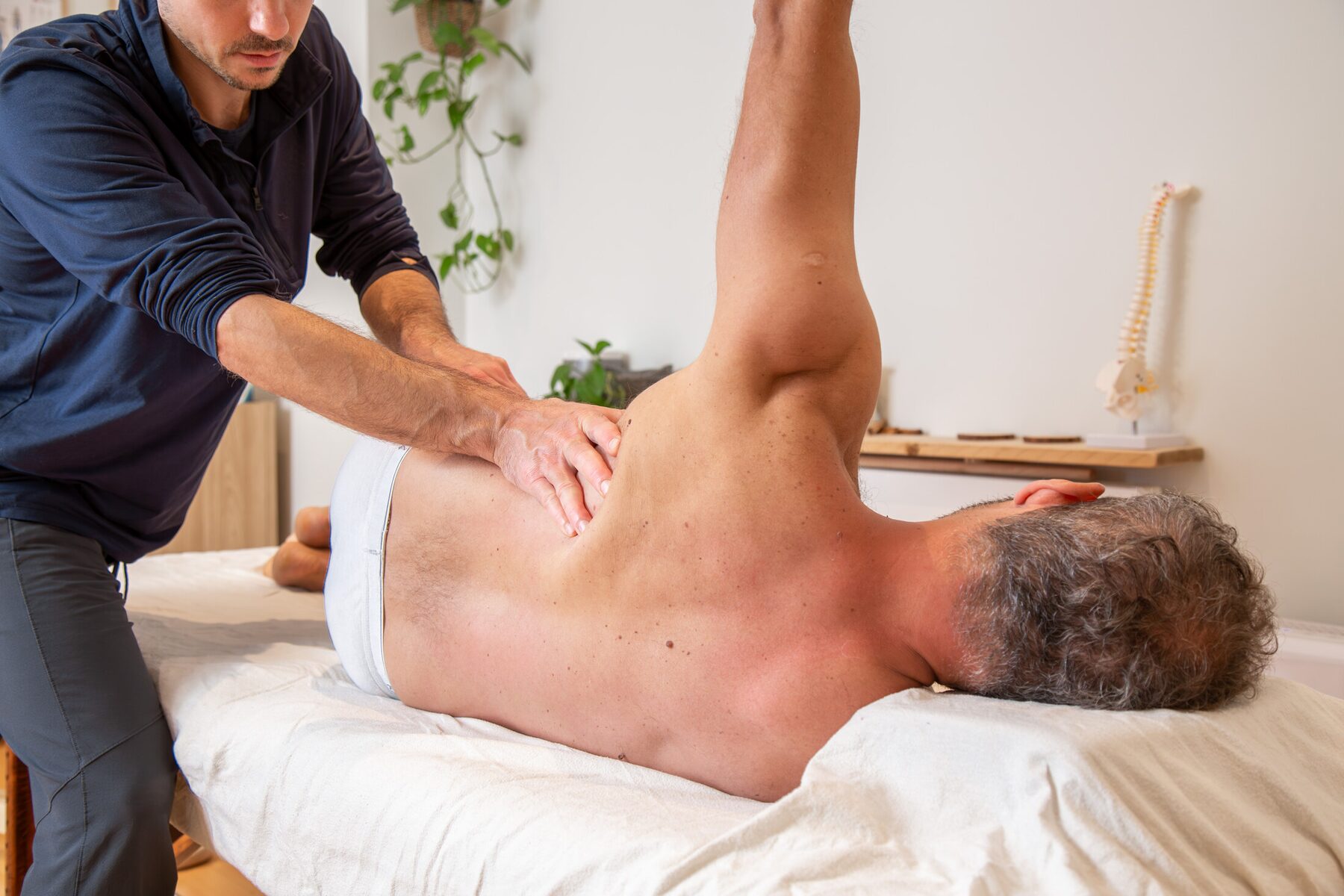
BodyReading is the observational approach used within Anatomy Trains. Standing organisation is considered from different perspectives, without judging posture against a fixed ideal.
What can be seen is brought together with conversation and with what the person is experiencing from within. From this, a working intention begins to emerge: where greater adaptability, support or differentiation may be useful.
Movement assessment
Standing posture is only one part of the picture.
Simple movements can reveal relationships that are less apparent when the body is still—how weight transfers through the feet, how the pelvis and spine respond to movement, or how different regions cooperate with one another.
Assessment therefore continues throughout the session rather than being confined to its beginning.
Hands-on fascial work
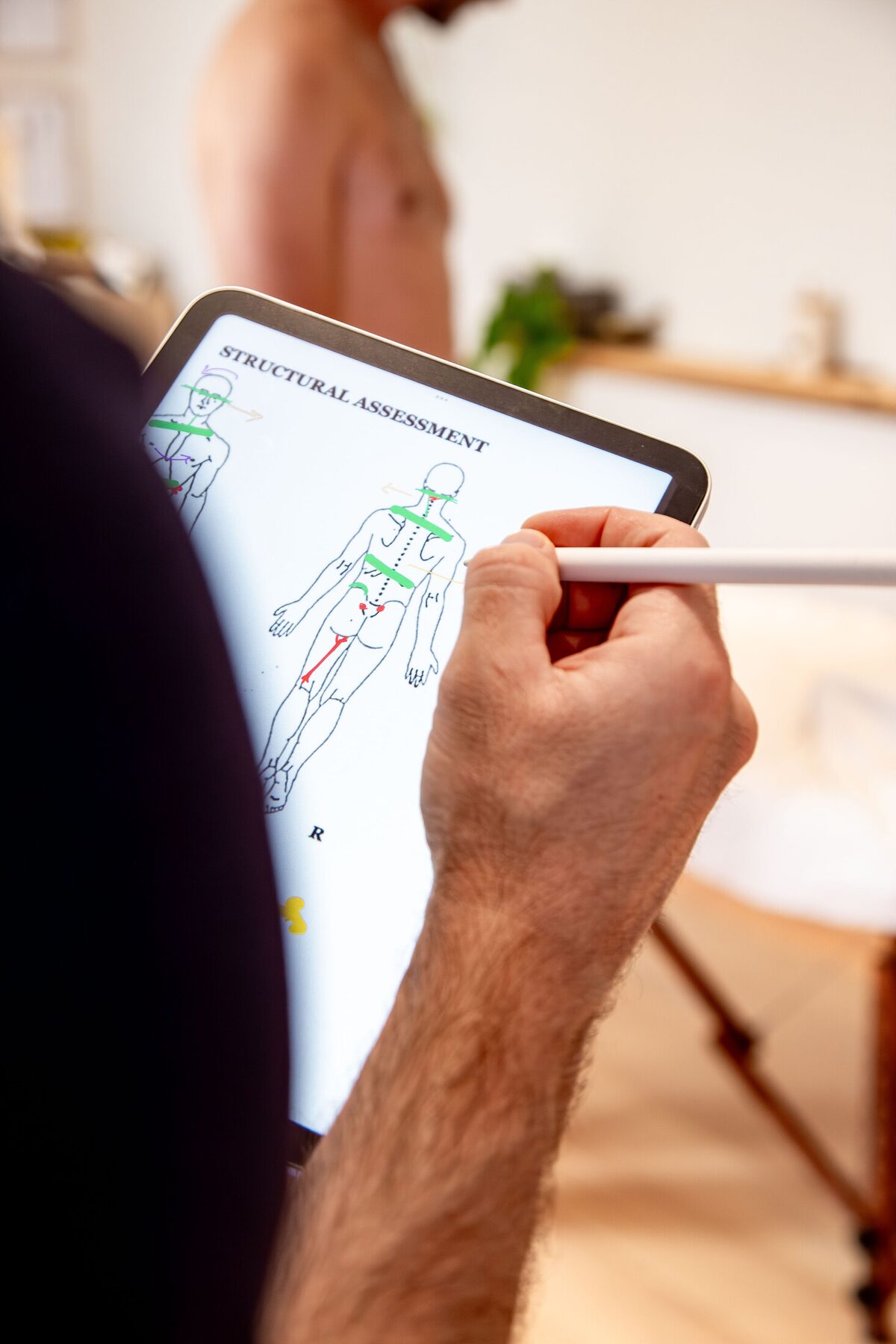
The hands-on work is specific and deliberate. Different qualities of touch and movement are used to engage the fascial and myofascial tissues, with the direction, pace and depth of the work determined in response to the individual rather than through a standard sequence of techniques.
Although a session may concentrate on particular regions, the broader question remains how those regions relate to the organisation of the whole.
Active movement and integration
ATSI is not entirely passive.
At different points you may be asked to make small movements while the tissue is being worked with, to breathe into a particular area, stand, walk or explore a movement again.
This allows change to be experienced and explored as it takes place, giving the nervous system an opportunity to recognise different possibilities for coordination and support.
An individual process
No two bodies organise themselves in exactly the same way. History, occupation, training, habitual movement, previous injuries and many other influences contribute to the patterns visible in the present.
ATSI therefore offers a structured framework without applying an identical solution to every person. BodyReading, movement and ongoing reassessment help determine how its principles are applied to the individual in front of me.
The process is collaborative. Nothing is imposed, and each stage requires the person's willingness and participation. The intention is not simply to make a change to the body, but to allow the person to experience, understand and take part in that change as it unfolds.
The process
Structural Integration can be experienced at different levels of depth.
A single session can be used for focused work around a particular structural or movement pattern. A three-session introduction provides a broader experience of the method, while the full twelve-session ATSI process works progressively through the body using the complete Anatomy Trains Structural Integration framework.
The Process page explains the different ways of beginning and what distinguishes each approach.